
Dear Friends,
Sometimes when we think about God we feel very dull and maybe even cold toward the very idea of God. We may be experiencing just low spirits or we may be so blue because we’ve been thinking about problems to do with health or finances or just about ourselves. Maybe we are brooding about wrongs done to us or about our own wrongs to do with lack of care for others or feelings of failure. Or maybe we’ve been suffering over memories of relationships with people that somehow have gone wrong; it could have been our fault or we may have shared the blame with others for such things. Lots of things get us down and we can get very depressed. We can let such feelings just take over and then we wonder, Does God care at all about me? And we may think, “If He does, probably He doesn’t like me, I’m such a mess and a failure.”

Do you know that in the midst of such an experience, God sees you? The Bible says “Neither is there any creature that is not manifest in his sight: but all things are naked and opened unto the eyes of him with whom we have to do” (Hebrews 4:13). If He thus sees us, isn’t the question then what He thinks of us, seeing us in all our confusion and lowliness and feeling miserable about ourselves? Isn’t this rather what we fear—that He is hard toward us?
What, indeed, does He think about you and me? What attitude does “the God who sees us” have toward us? Here’s what the Bible says: “For I know the thoughts that I think toward you, saith the Lord, thoughts of peace, and not of evil, to give you an expected end” (Jeremiah 29:11). God has “thoughts of peace, and not of evil” toward you. And what is “the expected end”? We hope for something good and lasting, that somehow when our end comes, it won’t be the true end, but something will follow. So is there a place for us in the world to come?
But if we allow ourselves to be led by our feelings, we can be misled into thinking we cannot expect anything in the end—it will all be over. But this is not what the Bible tells us, and the Bible claims to be the truth about life, man and God, about beginnings and about the end. The Bible, indeed, says there will be an end. And it says there is a purpose to our lives.
Do you know what the Bible says of our purpose? Remember, the Bible is no ordinary book—it is actually 66 different books and letters written over 1,500 years by some 40 different people, from the prophets of Israel to the apostles of Jesus and eyewitnesses of his life, death and resurrection. These all testify that God created all things, governs all things, that He is not aloof or disengaged, and that He is actively involved in the world that He made, guiding all things—great and small--according to His overarching plan. God is concerned with the events of your life. He is not shocked nor uncaring regarding your suffering in this world. He knows the hairs on your head, the Bible says, and the fears of your heart, and what the future holds for you. His purpose is that you should know Him, that you should have a personal relationship with Him, that He loves you! And the great hope the Bible holds out to us is that all those who trust in his mercy and forgiving love will know Him forever—that death is not the end, but the door to eternity. This is what we are told in the Bible’s Sermon on the Mount, where Jesus Himself says,
“Therefore I tell you, do not be anxious about your life, what you will eat or what you will drink, nor about your body, what you will put on. Is not life more than food, and the body more than clothing? Look at the birds of the air: they neither sow nor reap nor gather into barns, and yet your heavenly Father feeds them. Are you not of more value than they? And which of you by being anxious can add a single hour to his span of life? And why are you anxious about clothing? Consider the lilies of the field, how they grow: they neither toil nor spin, yet I tell you, even Solomon in all his glory was not arrayed like one of these. But if God so clothes the grass of the field, which today is alive and tomorrow is thrown into the oven, will he not much more clothe you, O you of little faith? Therefore do not be anxious, saying, ‘What shall we eat?’ or ‘What shall we drink?’ or ‘What shall we wear?’ For the Gentiles seek after all these things, and your heavenly Father knows that you need them all. But seek first the kingdom of God and his righteousness, and all these things will be added to you. “Therefore do not be anxious about tomorrow, for tomorrow will be anxious for itself. Sufficient for the day is its own trouble. (Matthew 6:25-34)
And in Matthew 10:29–33 Jesus also says this:
Are not two sparrows sold for a penny? And not one of them will fall to the ground apart from your Father. But even the hairs of your head are all numbered. Fear not, therefore; you are of more value than many sparrows. So everyone who acknowledges me before men, I also will acknowledge before my Father who is in heaven, but whoever denies me before men, I also will deny before my Father who is in heaven.
Do you see from Jesus’ own words that you are cared for by the most special man who ever lived, a man who was also God’s Son, the Messiah—the only man who never sinned, and the only man to be born again from the dead, never to die again?
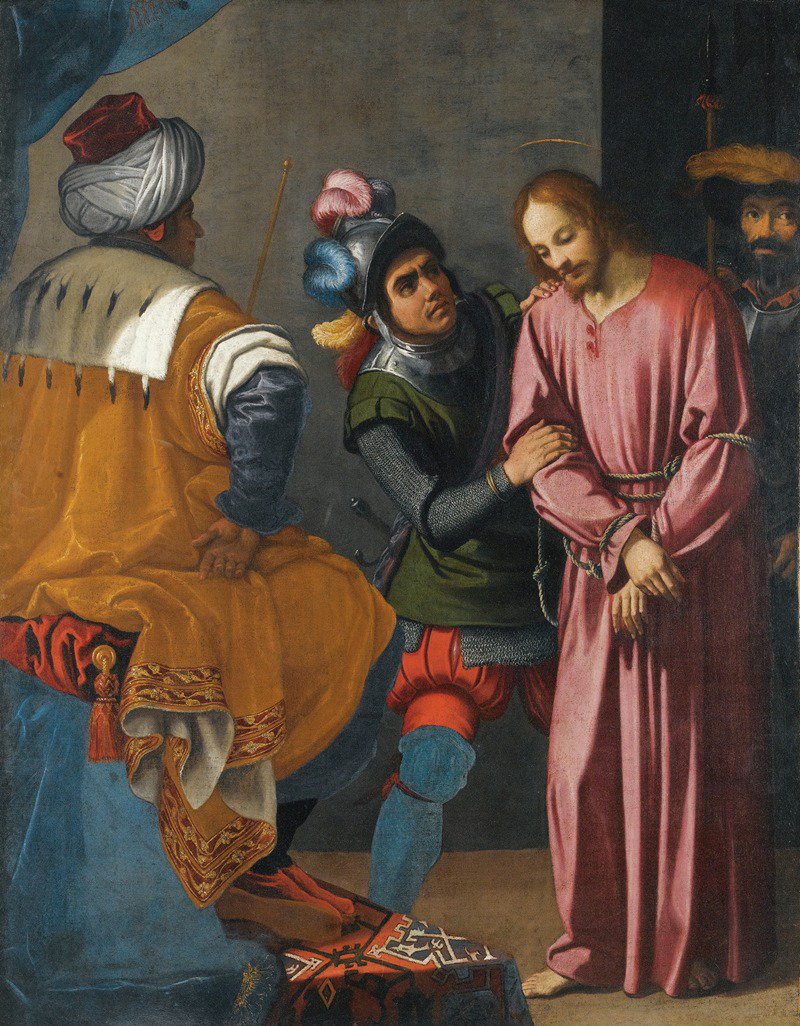
“Christ Before Pilate,” Agostino Ciampelli. c. 1600. Jesus, on the way to the cross, where he took the punishment for all our sins, but He Himself never sinned. He was the only innocent man who ever lived and so could be our Savior. He was a substitutionary atoning sacrifice, giving himself for you and me.
The Bible says His Father sent Him into the world specifically to show us His love for us, and above all to do this by His paying our debt to God’s justice—since every one of us IS guilty of many things that should make us feel lousy, worthless, condemned, and full of regret, shame and fear. But here’s the wonder: God sent Jesus to show us these things need not have any power over us at all. And why not? Because Jesus Himself took upon Himself the penalty all our sinful, rebellious, unworthy thoughts, feeling and actions deserve, satisfying thereby any just debt we may owe to God for our failings, our sins. And this is why Jesus is called “the Saviour,” because he, and he alone, can save us from all that would destroy us. He calls us, then, to repent and believe in Him.
And how does this happen? Because on the cross of Calvary he literally took upon himself—as the only innocent, sinless man who ever lived—all the penalty our rebellious hearts have deserved, and thus all the condemnation we walk around feeling when we feel low, depressed, unhappy, guilty and altogether low and miserable. Jesus came and paid the penalty which the perfect law of God demands for wrongdoing. What penalty is that? It’s death! And that is why Jesus died—to pay that debt we owe, you and I. God gives us a gift of faith to believe this!
Therefore, if by God’s grace we will only come to Jesus, confessing we deserve nothing but death and punishment for all our bad thoughts, attitudes, deeds and failure to do the right thing, and so trust Him to be our savior, trusting that what the Bible tells us is true, then we are delivered from the awful judgment we deserve.
This is why we should not believe in our feelings, no matter how low we feel, or how elated we may persuade ourselves to feel by forgetting our sins. No, we should instead believe in what the Bible tells us Jesus did for us, and what the Bible tells us Jesus thinks of us—and what the Bible says His Father thinks of us. And what is that? Hear what the Bible says:
“For God so loved the world, that he gave his only Son, that whoever believes in him should not perish but have eternal life. For God did not send his Son into the world to condemn the world, but in order that the world might be saved through him” (John 3:16-17)
If God gave His Son, shall He not give us all things? Indeed, He promises to give us heaven with Him and His Son, and a world of love there that has no end—“eternal life.” It’s almost too good to be true, but this is what the Bible tells us is God’s ultimate purpose and the end He has for all who believe. And as we read the Bible more and more we grow in faith that it’s all really true!
We are not to worry about all the things that will not last—and when we look about us we see that the only things that will last are the souls of other human beings. No, we should rather care about God’s disposition towards us—that is what we should care about. And His disposition is one of love, which is why He sent His Son to be our loving savior.
The famous John Bunyan, author of the 17th century novel, Pilgrim’s Progress, also wrote an autobiography, Grace Abounding to the Chief of Sinners. And in that book he tells of how he used to walk around feeling despised and rejected by both man and God—this was when he was a young man. But then he heard in his mind the Lord repeatedly telling him, “I love you.”
Don’t you know the Lord has the same thoughts towards you? He says to you, “I love you!” What can you reply? You can pray to the Father in Heaven the sort of prayer people like John Bunyan later prayed, realizing he was loved by God. You can say something like this:
“Father, I believe you mercifully sent Jesus to free me from being the slave of all sorts of bad feelings about myself, to free me from all sorts of guilt I justly feel, and above all from the just penalty for all my wrongs which otherwise would send me to death and hell. I believe you can do this only because Jesus took all the penalty for my sins upon Himself, thereby removing any obstacle between me and Thee, so that I might know You and be Yours—which is, after all, the true purpose of my life! And thus I would now be Yours through what You have done in sending Your Son, and through what Jesus has done in dying for me on the cross and then rising again from the dead by Your Power. O, Father, help me believe in all Your Son has done and said so I can have a hope I never dreamed of before and have eternal life with Thee.”
You can even pray this, too:
“O Father, in the time remaining to me in this old world, may I be closer to You and Your Son, my Savior, that I may know how to care for others and love others and know how much You love me. May I be used by Thee to help others know You and Your love. I cling, O God in Heaven, to what the Holy Bible says of You: `that in all these things we are more than conquerors [over depression and every enemy of our souls] through him who loved us. For I am sure that neither death nor life, nor angels nor rulers, nor things present nor things to come, nor powers, nor height nor depth, nor anything else in all creation, will be able to separate us from the love of God in Christ Jesus our Lord.’” (Romans 8:37-39).
When we come to the end of ourselves enough to know our only hope is in the promises of God about His Son in the Bible, we are at last on the road to true and lasting peace. We are then no longer the slave of moods and feelings that tell us we are miserable, unloved, unlovely, lonely, hopeless, lost and deserving of despair. No, it’s because of God’s mercy in sending Jesus that we are able to overcome all such things and know we are loved and lovely, hope-filled and capable, at last, of great and lasting joy and peace because we know our Savior and have a friend who can never fail us.
The author of the hymn, “How Firm A Foundation,” a greatly-loved 18th-century English hymn first published in 1787, understood the truth we have been talking about. The hymn was known far and wide for its most encouraging words about God’s care for us. It’s author was probably a man named Robert Keene. Greatly popular in America, the hymn has become a favorite of many:
How firm a foundation, ye saints of the Lord,
Is laid for your faith in His excellent word!
What more can He say than to you He hath said,
To you who for refuge to Jesus have fled?
“Fear not, I am with thee, O be not dismayed,
For I am thy God, and will still give thee aid;
I’ll strengthen thee, help thee, and cause thee to stand,
Upheld by My righteous, omnipotent hand.”
“When through the deep waters I call thee to go,
The rivers of sorrow shall not overflow;
For I will be with thee, thy troubles to bless,
And sanctify to thee thy deepest distress.”
“When through fiery trials thy pathway shall lie,
My grace, all sufficient, shall be thy supply;
The flame shall not hurt thee; I only design
Thy dross to consume, and thy gold to refine.”
“E’en down to old age all My people shall prove
My sovereign, eternal, unchangeable love;
And then, when grey hairs shall their temples adorn,
Like lambs they shall still in My bosom be borne.”
“The soul that on Jesus hath leaned for repose,
I will not, I will not desert to his foes;
That soul, though all hell should endeavor to shake,
I’ll never, no, never, no, never forsake!”
We are approaching the season of remembering the crucifixion of our Lord on a Friday and His resurrection three days later, on a Sunday—days we commonly now call “Good Friday” and “Easter.” It is fitting that we annually mark these days, but in reading the Bible we find that concern and even preoccupation with what happened on these two days is hardly limited in the Holy Scriptures to a once-a-year remembrance! No, the Bible again and again shows our entire hope as believers in Jesus Christ is wholly and essentially daily wrapped up in Jesus Christ’s death and resurrection! It’s a matter to occupy our thoughts daily—even hourly!
All of our sins were heaped upon Him and He took them upon Himself willingly, so that we might be saved from hell and God’s just wrath against sin and be reconciled to our Heavenly Father! The Apostle Paul expressed this in referring to his life’s work of sharing the Good News of who Jesus is with others everywhere he went. Here he’s speaking of Christ’s life, but focusing on the cross:
In Christ God was reconciling the world to himself, not counting their trespasses against them….We implore you on behalf of Christ, be reconciled to God. For our sake he made him to be sin who knew no sin, so that in him we might become the righteousness of God. (II Corinthians 5:19-21)
You see? Jesus took our sin upon Himself, though He had never sinned, so that we might be forgiven. This same Apostle Paul stressed—and I mean really stressed—that for the believer in Jesus, hope is not only in Christ’s death, as precious as that is to us for the reasons we’ve just tried to describe, but in His also rising from the dead. Friends, He is Risen! This is the source of our most precious hope and it underscores what we have been saying here about the purpose of our lives according to God’s Word: that we might know Him and His Son, Christ Jesus, and enjoy friendship and fellowship with God and all those who love Him forever!
Be encouraged, then, by the fact that He is risen, that He loves you, that we have a real hope because of Christ’s death for our sins and his rising again! He is alive in Heaven and He loves you! Jesus Christ will return someday—and that day is coming closer all the time. And then He will establish His Kingdom which will never end!
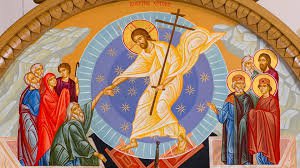
The Resurrection of Jesus Christ, Teplodar, from a church in Teplodar, Odessa, Ukraine.
This painting shows us the Risen Christ and teaches that that the victory of Christ over death is complete for all time. We see Jesus in a garment billowing upwards to indicate his direction of travel, up from the grave! Jesus holds a cross, reminding us that he was nailed to his cross and died for our sins. Jesus is surrounded by blue concentric circles studded with gold stars, representing the light of Christ we read of in John’s Gospel which says Jesus is “the Light of the World.” This is light that darkness could not overcome. Jesus is shown pulling an old man in green from the tomb which we see on our left. This is Adam, the first man, illustrating Christ’s victory as the ‘new Adam’ who redeems humanity from the beginning. Eve wearing red behind Adam is waiting to be rescued next. Jesus is taking hold of Adam, showing that if we reach out to God, he is ready to take us to Himself. The first figure on the other side is John the Baptist. His presence signifies the story of salvation which he heralded. Jesus is shown here reaching out to fallen men and women, a Savior to so many—to people just like us! Oh, let us trust Him! May God bless and strengthen you!
~ Paul